Mount Kenya National Park, a UNESCO World Heritage Site, was established in 1949.
It protects the region surrounding Mount Kenya, the second-highest peak in Africa.
The park covers an area of 715 square kilometres. It is located approximately 175 kilometres north-east of Nairobi.
The park serves as a critical water catchment area for Kenya. The Kenya Wildlife Service (KWS) administers it.
KWS sets and enforces the fee structure for all visitors.
Distinct Ecosystems and Vegetation Zones
The park features a series of distinct altitudinal vegetation zones.
Dry upland forest covers the lower slopes. This transitions into montane forest rich in cedar and podocarpus.
A dense bamboo zone lies above this area. It gives way to the upper timberline forest, dominated by Hagenia and giant heath.
The Afro-alpine zone begins at approximately 3,800 metres. It features a unique landscape of moorlands with tussock grasses, giant groundsel (Dendrosenecio), and giant lobelias.
The highest regions consist of rock, ice, and the mountain's three main peaks.
Notable Wildlife and Bird Species
Mount Kenya National Park functions primarily as a trekking destination. It hosts a range of wildlife species.
The forest zones are home to black-and-white colobus monkeys, Sykes' monkeys, bushbucks, and cape buffalo.
Larger mammals such as elephants are present. Elusive species like the forest hog, suni, and various duikers also reside here.
The high-altitude tree hyrax is a common resident.
Birdlife is abundant. Raptors like the crowned eagle and lammergeier are often sighted, in addition to olive pigeons and mountain buzzards.
Popular Climbing Routes and Peaks
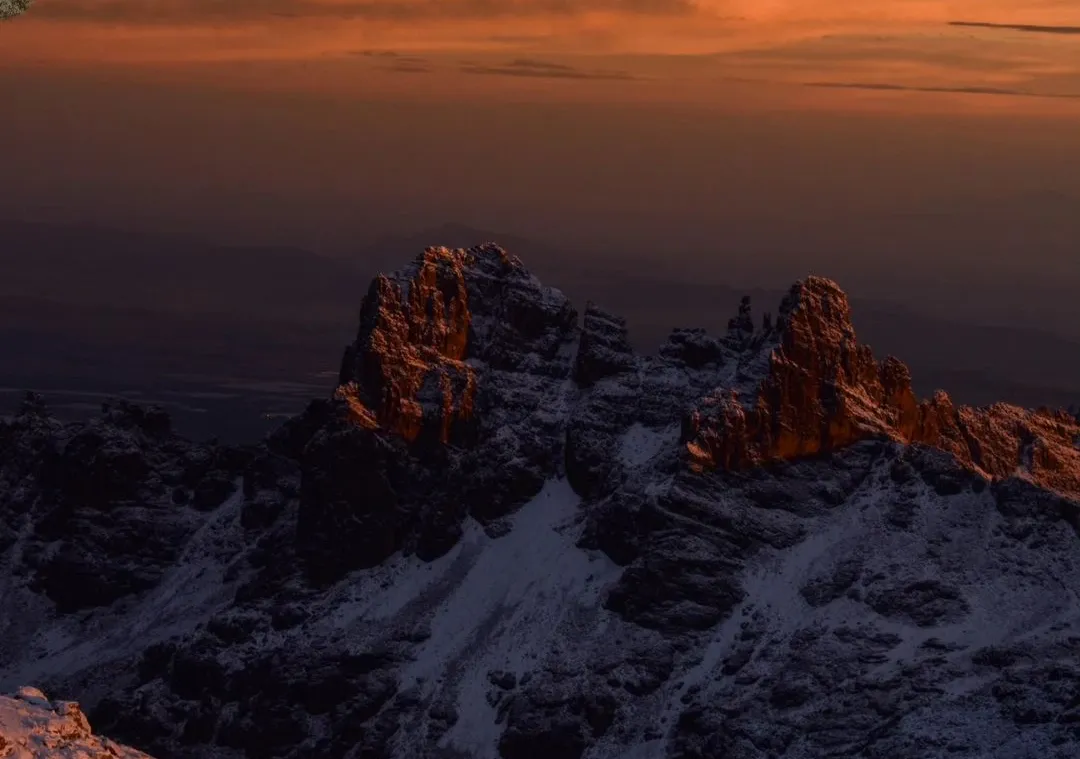
Mount Kenya has three main peaks. Batian (5,199 m) and Nelion (5,188 m) are technical climbing summits.
Point Lenana (4,985 m) is the most accessible peak for trekkers.
Access to the peaks occurs primarily via three main routes:
- Naro Moru Route: This route is the most direct and popular. It is known for its steep ascent and the challenging "Vertical Bog."
- Sirimon Route: This route is one of the most scenic routes. It approaches from the north-west and offers a more gradual ascent through diverse vegetation zones.
- Chogoria Route: This route approaches from the east. It is known for its dramatic scenery, including gorges, tarns, and waterfalls like the Gorges Valley and Lake Michaelson.
Kenya Entry Requirements for Visitors
Logistical planning for a trip to Mount Kenya involves two distinct processes.
Visitors must secure authorisation to enter the Republic of Kenya. They must also purchase specific permits to enter the National Park.
These are separate requirements handled by different government bodies.
Mandatory Electronic Travel Authorisation (eTA)
All international visitors entering Kenya must apply for an Electronic Travel Authorisation (eTA) prior to their departure.
The eTA system has replaced the previous visa system.
Visitors submit applications online. Travellers should apply at least 72 hours before travel to allow for processing.
Visitors require a valid passport and the approved eTA for country entry.
KWS Park Permits via eCitizen
Entry into Mount Kenya National Park requires a separate permit once in Kenya.
Visitors purchase this permit from the Kenya Wildlife Service.
Visitors must pay all KWS park fees digitally via the government's eCitizen platform.
Park gates only accept digital payments.
Visitors must create an account on the eCitizen portal to process payments and generate entry permits.
2026 Mount Kenya National Park Entrance Fees
The Kenya Wildlife Service (KWS) will implement its Premium Park Rates effective 1st January 2026.
All fees are valid for a 24-hour period from the time of entry.
Visitors must present a valid identification document at the entry gate.
This includes a National ID for citizens, an Alien ID for residents, or a Passport for non-residents.
KWS Wilderness Parks B Classification
KWS categorises Mount Kenya National Park as a 'Wilderness Park B'.
This classification reflects its status as a remote, high-altitude conservation area.
The park focuses on trekking and mountaineering activities rather than traditional vehicle-based game drives.
The fee structure for this category is distinct from that of savannah parks like Amboseli or Maasai Mara.
Park Entrance and Climbing Packages (Effective 2026)
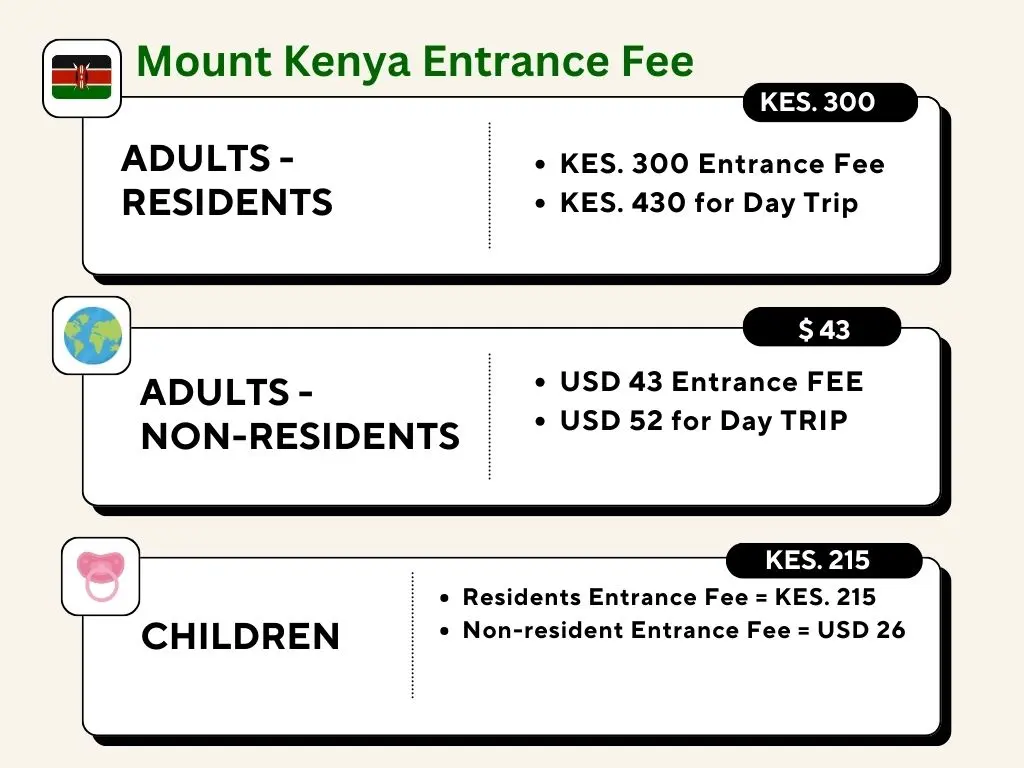
The following table outlines the consolidated entrance and multi-day climbing package fees.
These rates are inclusive of the daily conservation fee. They are charged per person.
The multi-day packages offer a bundled rate for continuous stays within the park for trekking purposes.
| Category / Duration | East African Citizen/Resident (KSH) | Non-Resident (USD) |
|---|---|---|
| Daily Entrance Fee (Adult) | 500 | 60 |
| Daily Entrance Fee (Child/Student) | 250 | 35 |
| 3-Day Climbing Package (Adult) | 1,950 | 235 |
| 3-Day Climbing Package (Child/Student) | 975 | 115 |
| 4-Day Climbing Package (Adult) | 2,600 | 310 |
| 4-Day Climbing Package (Child/Student) | 1,300 | 155 |
| 5-Day Climbing Package (Adult) | 3,250 | 385 |
| 5-Day Climbing Package (Child/Student) | 1,625 | 195 |
| 6-Day Climbing Package (Adult) | 3,900 | 460 |
| 6-Day Climbing Package (Child/Student) | 1,950 | 230 |
Vehicle and Aircraft Fees
Fees for vehicles entering the park are charged per day. They are based on carrying capacity.
Aircraft fees apply for a single landing.
| Vehicle / Aircraft Type | Fee (KSH) |
|---|---|
| Vehicle (Less than 6 seats) | 300 |
| Vehicle (6 - 12 seats) | 1,030 |
| Vehicle (13 - 24 seats) | 2,585 |
| Aircraft (Less than 3 seats) | 300 |
| Aircraft (3 - 6 seats) | 500 |
| Aircraft (7 - 14 seats) | 1,000 |
Special Activities and Service Fees
KWS offers specific services within the park at an additional cost.
Visitors must arrange and pay for these services via the eCitizen portal.
| Activity / Service | Fee (KSH) |
|---|---|
| Security/Guided Tour (per guide, up to 4 hours) | 1,720 |
| Security/Guided Tour (per guide, over 4 hours) | 3,015 |
| Night Game Drive (per person, per trip) | 2,155 |
| Vehicle Recovery (inside park) | 7,500 |
How to Obtain Mount Kenya Entrance Permits
All permits for Mount Kenya National Park must be acquired digitally before arriving at the gate.
The official government services platform centralises the process.
Applying via the eCitizen Platform
- Access the Portal: Navigate to the KWS eCitizen portal at kws.ecitizen.go.ke.
- Account Registration: New users must create an account. Kenyan citizens use their National ID number. Residents use their Alien ID number. International visitors must use their passport details.
- Select KWS Services: Once logged in, navigate to the Kenya Wildlife Service section. Select 'Park Entry'.
- Complete the Application: Choose Mount Kenya National Park. Specify the number of visitors (adults and children). Select the duration of stay or package. Add any vehicle details.
- Process Payment: Pay the calculated fees using one of the available digital payment methods (e.g., mobile money, credit/debit card).
- Download Permit: After successful payment, download the official permit or invoice. This document contains a QR code. KWS personnel will scan this at the park gate.
Understanding Park Permit Validity
A daily entrance permit is valid for 24 hours.
Multi-day climbing packages are valid for the continuous number of days purchased.
For example, a 4-day package is valid for 96 hours from the time of first entry.
There is no re-entry on a standard daily permit. Exiting the park requires the purchase of a new permit to re-enter.
Essential Mount Kenya Fee Information
Visitors must adhere to the following logistical requirements and regulations to ensure a smooth entry process.
- Payment Methods: Only cashless payments are accepted through the eCitizen portal. Major credit cards (Visa, MasterCard) and local mobile money services (M-Pesa) are the primary methods.
- Age Classifications: A 'Child' is defined as a person aged between 3 and 17 years. Persons 18 years and above are classified as 'Adults'. 'Students' must be 23 years old or younger. They must provide a valid student ID from a recognised institution.
- Fee Terms: Park fees are non-refundable and non-transferable. All fees are subject to 16% Value Added Tax (VAT) and other applicable government taxes.
Mount Kenya Logistics and Park Regulations
Park Gates and Access Points
Mount Kenya National Park is accessible through several gates.
Each gate corresponds to a specific climbing route.
The primary gates are:
- Naro Moru Park Gate: This gate serves the Naro Moru route.
- Sirimon Park Gate: This is the starting point for the Sirimon route.
- Chogoria Park Gate: This is the main entry point for the Chogoria route.
Park Rules and Regulations
Compliance with KWS regulations is mandatory for visitor safety and ecosystem protection.
- Operating Hours: Park gates operate from 06:00 to 18:00 daily. Visitors can only enter and exit within these hours.
- Speed Limit: KWS enforces a maximum speed of 40 kph (25 mph) on all park roads.
- Stay on Trails: KWS strictly prohibits off-road driving or trekking off designated paths. This prevents environmental degradation.
- Wildlife Distance: Maintain a minimum distance of 20 metres from all wildlife. Do not feed or attempt to touch any animals.
- Waste Disposal: All litter must be carried out of the park. KWS strictly enforces the 'Leave No Trace' principle.
- Vehicle Conduct: Remain inside your vehicle except in designated picnic or viewpoint areas. Keep all doors closed. Avoid playing loud music or using vehicle horns.